

.png)
Summary
- Generic sales training fails manufacturing reps because it ignores unique challenges like long sales cycles, technical complexity, and multi-person buying committees.
- The biggest gap in sales training is often application, not knowledge; companies spend over $30 billion annually on training, but much is wasted without field reinforcement.
- Leaders should diagnose their team's core issue—be it long ramp times, inconsistent process, or poor value selling—to select the right training approach, from methodology workshops to structured field coaching.
- To tackle long ramp times and prepare reps for complex objections, teams use AI Sales Roleplays to provide scalable, realistic practice, reducing ramp time by over 50%.
You search for "sales training" and get a course built for a SaaS rep selling a $99/month subscription. It talks about discovery calls, handling "is now a good time?" objections, and closing in one or two touches. Meanwhile, your team is six months into a deal, presenting to a five-person buying committee made up of plant engineers, procurement managers, and a CFO who wants total cost of ownership — not a product demo.
This is the core problem with most manufacturing sales training: it's built for the wrong seller.
Sales engineers and industrial reps face a completely different selling reality. As one sales engineer put it on Reddit, "there is a noticeable lack of tailored sales training for sales engineers in complex solution industries." Most onboarding programs are unstructured, dependent on manager discretion, and light on the practical skill development needed for complex, long-cycle deals. The result? Steep learning curves, missed quota, and reps who know the product but can't navigate the buying committee.
Industrial sales has four challenges that generic training completely ignores, according to ASLAN Training:
.png)
The best manufacturing sales training programs are built around these realities. Below, we've broken down 8 top programs by training approach — and evaluated each one against the criteria that matter to industrial sales leaders: technical product depth, long-cycle objection handling, dealer/channel support, and measurable ramp outcomes.
1. AI Roleplay & Simulation: Hyperbound Practice
Best for: Reducing ramp time, scalable objection handling practice, and mastering complex multi-stakeholder conversations
The biggest gap in most manufacturing sales training isn't knowledge — it's application. Reps know the product. They've sat through the methodology workshop. But when they're standing in front of a skeptical procurement manager asking why your lead time is two weeks longer than the competitor's, all that theory evaporates.
Hyperbound Practice solves this with on-demand AI roleplay simulations built for exactly these moments. The platform lets reps practice technical product walkthroughs, objection handling, and multi-stakeholder conversations in a safe, repeatable environment — before they're in front of a real buyer.
How it addresses manufacturing sales challenges:
- Technical complexity: Reps can run full product demos using the Demo Call Screen Sharing feature, practicing live walkthroughs of capital equipment or complex solutions with AI buyer personas that push back like real engineers would.
- Buying committees: Multiparty Roleplays allow a rep to simultaneously practice with multiple AI personas — an engineer focused on specs, a CFO focused on ROI, a plant manager worried about downtime — mirroring the real dynamics of industrial purchasing decisions.
- Long-cycle objection handling: Bitesized Roleplays let reps drill specific objections that come up in long industrial cycles ("We're locked into our current supplier," "Your pricing is 20% higher — justify it"). AI Scorecards and AI Coaching provide immediate, objective feedback on talk ratios, methodology adherence, and missed opportunities.
What separates Hyperbound from generic AI tools is the data underneath it. The AI buyer personas are trained on 2M+ hours of real B2B sales conversations — directly addressing the common concern that "AI tools lack the ability to replicate the nuances of real-life sales interactions." These aren't scripted bots. They respond dynamically, the way real procurement heads and plant engineers actually do.
Proven outcomes: Nivoda used Hyperbound and achieved a 50% reduction in ramp time and a 150% increase in demo conversion rates — Rob Rangel, Director of Sales Performance. Vanta reduced ramp time from 210 to 72 days (60% faster).
.png)
2. Classroom & Virtual-Led Training: Richardson Sales Performance
Best for: Foundational methodology, engaging modern buyers earlier in the process
Richardson offers blended learning programs specifically tailored for manufacturing and industrial sales teams. Their approach centers on customer-centric selling and agile methodologies — particularly useful for teams whose reps still lead with product features instead of insight-led questions.
Their training focuses on helping reps influence the buying process earlier, a critical skill when industrial buyers often define their requirements (and shortlist vendors) before ever picking up the phone. Clients report a 30% average revenue increase and 21% outperformance versus peers.
.png)
3. Blended Learning: RAIN Group
Best for: Building a consistent sales language across teams with mixed experience levels
RAIN Group provides a full-cycle training system covering prospecting, discovery, value justification, and negotiation. It's particularly valuable for industrial sales organizations where rep experience levels vary widely — seasoned field veterans alongside newer technical hires who are still learning to frame a value proposition.
Their structured approach gives everyone the same framework for approaching complex industrial accounts, which matters when multiple reps are touching the same buying committee. Some RAIN Group clients have reported up to 75% revenue growth post-implementation.
.png)
4. Value Selling & Mindset: Integrity Solutions
Best for: Teams struggling with pricing pressure and commoditization
When your reps are getting beaten on price by a competitor offering an inferior product, the problem usually isn't the product — it's a failure to communicate total value. Integrity Solutions addresses this directly, with programs built around Value Selling and developing a customer-centric mindset.
Their training extends to sales managers, recognizing that coaching can't be optional if behavior change is the goal. This makes it particularly effective for industrial organizations where field managers are the primary reinforcement mechanism for any new skill.
.png)
5. Systematic Methodology: Sandler Training
Best for: Engineers transitioning into sales who need a logical, repeatable system
Sandler's highly structured selling system is a natural fit for former engineers who appreciate a step-by-step process over an improvisational approach. It covers upfront contracting, systematic qualification, and objection-prevention techniques that are particularly effective in long industrial sales cycles where unqualified deals can drain months of resources.
The Sandler system is product-agnostic by design, which means it requires your own product training as a complement. Its strength is the rigorous process — which is exactly what helps technical reps build sales confidence without abandoning their engineering instincts.
.png)
6. Practical Skills & Rapport: SOCO Sales Training
Best for: Teams who need practical, real-world skills with built-in measurement
SOCO emphasizes rapport-building and practical communication skills specifically within the industrial sector. A standout feature: post-training evaluations that measure whether skills actually transferred — a differentiator in a landscape where most programs deliver training and disappear.
This aligns with evaluation best practices like the Kirkpatrick Model's Level 3 (Behavior), which focuses on whether training actually changes how reps behave in front of buyers. For industrial teams where relationships drive long-cycle deals, this focus on measurable behavior change is particularly relevant.
.png)
7. Customer-Centric Discovery: ASLAN Training
Best for: Teams selling long-term partnerships where trust is the primary competitive advantage
ASLAN's "Other-Centered®" methodology puts the customer's needs at the center of every interaction. It's particularly powerful for complex industrial sales where the goal isn't a single transaction — it's becoming a trusted partner for a plant manager or procurement director who'll still be buying from you in ten years.
Their framework teaches Deeper Discovery — using permission-based questions to uncover the motivations and internal dynamics that never appear in an RFP. This is the kind of training that can help a sales engineer move from product-pitcher to trusted advisor, directly addressing the manufacturing sales challenge of navigating complex decision-making processes.
.png)
8. In-the-Field Application: Structured Field Coaching Programs
Best for: Bridging the gap between training theory and real-world execution
This isn't a single vendor — it's the most underrated approach in industrial sales development. Structured field coaching means managers or dedicated coaches join reps on live calls (or review recordings) and deliver immediate, contextual feedback. It's shadowing done systematically, with scorecards and a clear feedback loop rather than informal debriefs in the parking lot.
It's also where most training investment goes to die. Companies spend over $30 billion annually on sales training, and a significant portion is wasted because there's no reinforcement mechanism in the field.
To make this approach scalable, tools like Hyperbound's AI Real Call Scoring can automatically analyze 100% of calls, surfacing coachable moments so managers can focus their time on the conversations that matter most — rather than manually reviewing hours of recordings.
.png)
The Decision Framework: What Does Your Team Actually Need?
If your reps can't handle a 6-month sales cycle and a 5-person buying committee, a one-day workshop won't fix it. Industrial sales demands continuous development — not a training event you check off once a year.
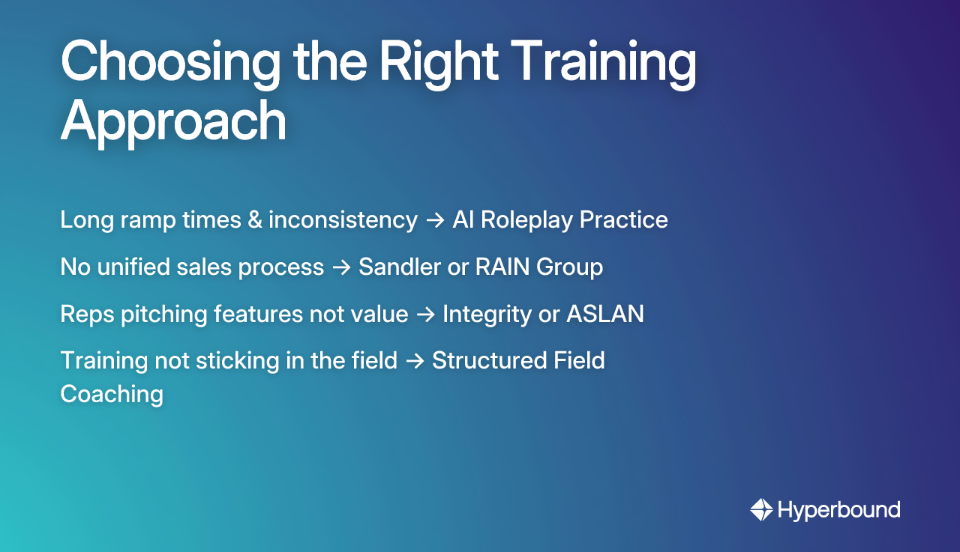
Here's a simple framework for choosing the right approach:
If your #1 problem is long ramp times and inconsistent execution...→ You need scalable practice. Hyperbound Practice gives reps a safe, repeatable environment to master messaging, handle objections, and build confidence before they're in front of real buyers. The Nivoda proof point — 50% faster ramp, 150% demo rate increase — makes the ROI case for industrial sales leaders.
If your team lacks a unified sales process...→ You need a foundational system. Sandler or RAIN Group can install a consistent operating language across your organization — critical when multiple reps are touching the same buying committee on a capital equipment deal.
If veteran reps are stuck pitching features instead of value...→ You need a mindset shift. Integrity Solutions or ASLAN can move experienced reps from product-pitcher to trusted advisor — which is the only way to win on anything other than price.
If training happens but nothing changes in the field...→ You need to operationalize coaching. Implement a structured field coaching program and use technology to ensure managers are reinforcing the right behaviors. AI scorecarding tools remove the bottleneck of manual call review and make coaching scalable across distributed industrial teams.
The best manufacturing sales training programs don't just teach reps what to do — they create the conditions for reps to actually do it, repeatedly, in front of real buyers with real quotas on the line. That's the difference between a training budget spent and a revenue outcome earned.
Frequently Asked Questions
Why is specialized sales training necessary for the manufacturing industry?
Specialized training is critical because generic sales programs fail to address the unique challenges of industrial sales. Manufacturing and industrial sales involve long sales cycles (months or years), complex multi-person buying committees (engineering, procurement, C-suite), deep technical product complexity, and intense price competition focused on the total cost of ownership. Training must be tailored to these realities to be effective.
What is the most effective way to train sales engineers on objection handling?
The most effective way is through consistent, realistic practice in a safe environment. AI roleplay platforms like Hyperbound are built for this, allowing sales engineers to drill specific, high-stakes objections they will face from technical buyers. This builds "muscle memory" and confidence, so they can handle pushback on pricing, lead times, or competitor features without getting flustered in front of a real customer.
How can I measure the ROI of a manufacturing sales training program?
You can measure ROI through a combination of leading and lagging indicators. Leading indicators are immediate behavioral changes, like improved adherence to sales methodology or higher scores on practice simulations. Lagging indicators are the business results that follow, such as a reduction in new hire ramp time (e.g., 50% faster ramp), an increase in demo-to-close conversion rates, and ultimately, higher quota attainment and revenue growth.
How does AI roleplay help reduce new hire ramp time?
AI roleplay accelerates ramp time by providing a scalable platform for new reps to practice real-world scenarios on demand. Instead of relying solely on shadowing senior reps, new hires can run dozens of simulated product demos, navigate multi-stakeholder conversations, and handle common objections. They receive instant, objective feedback from the AI, allowing them to learn and iterate far more quickly than traditional onboarding methods permit.
What should a good sales training program for complex buying committees include?
A strong program must include multi-stakeholder simulation. Reps need to practice navigating the conflicting priorities of different committee members—like an engineer focused on technical specs, a CFO focused on ROI, and a plant manager concerned with implementation downtime—all in the same conversation. This teaches them how to tailor their messaging and build consensus across the entire buying team, which is essential for closing large industrial deals.
How can sales training help my team defend against price competition?
Effective training helps your team shift the conversation from price to total value and long-term cost of ownership. This involves equipping them with the skills to conduct deeper discovery, build a strong business case based on the customer's specific needs, and articulate the value of your solution beyond its features. Programs that focus on value-selling or provide practice on value justification help reps confidently defend their price and avoid unnecessary discounting.
Book a demo with Hyperbound


